
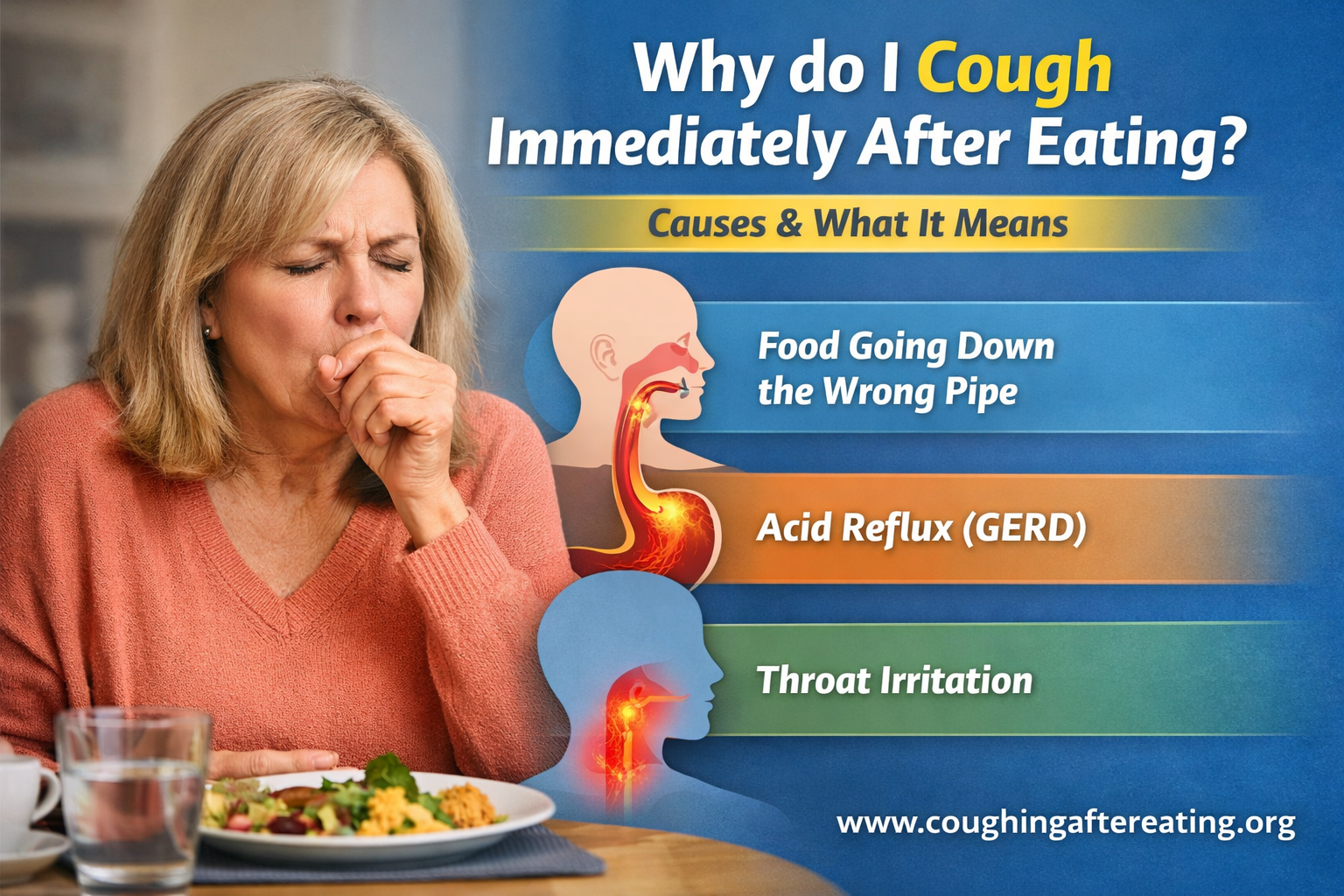
Why do I cough immediately after eating? Causes and what it means
Coughing immediately after eating or right after swallowing usually happens when something irritates or enters the airway too quickly. When the cough starts right away, the trigger is usually happening during swallowing or immediately after it, rather than later in digestion.
This timing matters because it often points to a different set of causes than delayed coughing after meals. In simple terms, an immediate cough after eating is usually a swallowing-phase or throat-level event, not a slower stomach-related one.
If you want a broader understanding of how different causes connect, the coughing after eating causes guide explains the full picture.
Mechanism: Immediate coughing after eating happens when food, liquid, or irritation triggers the airway during the swallowing phase, activating a rapid protective cough reflex before digestion begins.
if it happens shortly after → think reflux;
if it happens much later → think digestion
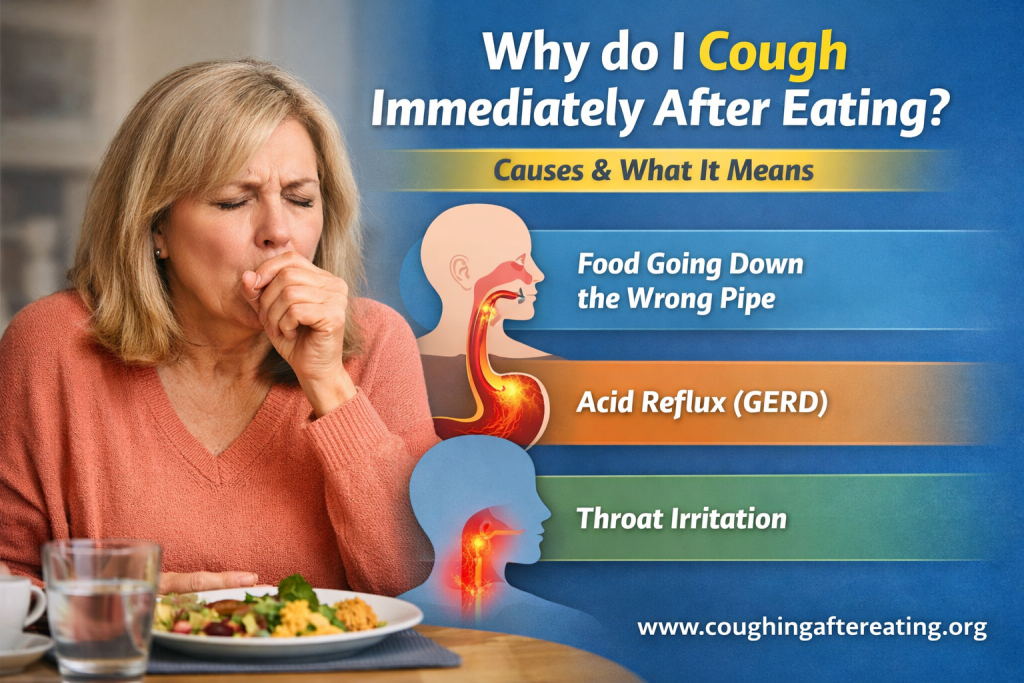
What it means if you cough immediately after eating
When coughing starts immediately after eating, it usually means the trigger is happening in the swallowing phase or just as food passes through the throat.
This contrasts with delayed coughing, which usually develops later and is more often linked to reflux or digestion-related irritation. Immediate coughing often points more toward airway involvement, quick irritation, or sensitivity than toward slower digestive causes.
This pattern is more likely if the cough begins within seconds of swallowing, happens during the meal itself, or appears with the first few bites rather than later after finishing food. In many cases, the body is reacting instantly to protect the airway.
Understanding this timing helps narrow down the likely causes and makes it easier to identify patterns in your symptoms.
Common causes of coughing immediately after eating
There are several possible reasons why coughing may begin right after eating. The symptom can feel similar each time, but the underlying causes can be quite different.
The most useful clues usually come from pattern recognition: whether the cough happens during swallowing, with the first bite, only when eating quickly, with liquids, or after certain foods.
Food going down the wrong way (most common cause)
One of the most common reasons is that a small amount of food or liquid enters the airway instead of the food pipe. This triggers a protective cough reflex immediately.
When coughing happens during swallowing or within a few seconds of food entering the throat, airway entry is often a more likely explanation than reflux. This is especially true when the cough is sudden, brief, and clearly linked to a specific bite or sip.
This can happen if you eat too quickly, talk while eating, or have mild swallowing coordination issues. Even small and occasional episodes can trigger noticeable coughing. If this happens frequently, it may suggest a swallowing problem that needs closer attention.
Persistent coughing with solids, liquids, or both can sometimes reflect impaired swallowing coordination, especially when the same pattern repeats across multiple meals.
A deeper explanation is available in aspiration when eating and coughing: causes explained, which explores how this process works.
Sudden reflux or throat irritation (less common but possible)
In some cases, stomach contents or acid can move upward quickly after eating and irritate the throat or airway.
This is usually more likely when coughing happens after larger meals, after bending or lying back, or after known trigger foods rather than during the exact act of swallowing. In some people, reflux can trigger coughing almost immediately after eating.
Unlike swallowing-related coughing, reflux-related coughing is often linked to meal size, pressure in the stomach, bending forward, or specific trigger foods. It may happen quickly in some people, but it is usually less tightly linked to the precise moment of swallowing.
To understand how this happens, see can acid reflux cause coughing after eating. If reflux is a suspected cause, see why GERD causes coughing after eating for a more detailed breakdown.
Airway sensitivity (quick-reacting throat)
Some people have a more reactive airway, which means even minor triggers can activate the cough reflex.
This kind of response is recognised when the throat or airway becomes easily irritated by temperature, texture, spice, or even normal swallowing. In these cases, the airway responds quickly to small changes during or after eating.
Cold foods, spicy ingredients, dry textures, or even normal swallowing can act as triggers, causing the cough to begin immediately even without obvious choking or reflux.
This type of reaction is often linked more to throat-level irritation than deeper airway issues. For a related pattern, see why do I keep clearing my throat after eating.
Dry throat or rapid eating (simple but common trigger)
A dry throat or eating too quickly can also trigger immediate coughing.
When food is swallowed without enough moisture or proper chewing, it can briefly irritate the throat. Rapid eating also increases the chance of poor coordination between breathing and swallowing.
This explanation is more likely if coughing improves when you slow down, chew more thoroughly, take smaller bites, or sip water between mouthfuls. Simple adjustments such as slowing down, chewing well, and staying hydrated can reduce this type of irritation. If the irritation feels more dryness-related than choking-related, this may overlap with why do I keep clearing my throat after eating.
How immediate coughing differs from other causes of coughing after eating
Immediate coughing after eating follows a very specific pattern that helps distinguish it from other causes. The key difference lies in timing, trigger, and sensation. Immediate coughing happens within seconds of swallowing and usually points to a swallowing or airway trigger. When coughing develops later, it is more often linked to reflux or digestion-related irritation. Understanding these differences helps narrow down the likely cause and avoid confusion between similar symptoms.
Timing clues that separate immediate vs delayed coughing
Timing is one of the most reliable ways to identify the cause of coughing after eating.
Coughing that begins during swallowing or within a few seconds usually points to airway involvement, swallowing coordination, or immediate throat irritation.
In contrast, coughing that appears minutes after eating is more likely related to reflux, digestion, or irritation building over time. This type of delayed response often follows larger meals or specific trigger foods. Comparing this pattern with silent reflux coughing after eating can help clarify how delayed symptoms behave differently.
If your symptoms are not clearly immediate, it may help to review silent reflux coughing after eating to better understand delayed patterns.
Compared with reflux-related patterns
Reflux-related coughing follows a different pattern from immediate coughing. Instead of starting right away, it usually develops after food has reached the stomach and contents begin to move upward.
This type of coughing is more likely when symptoms appear after larger meals, lying down, bending forward, or eating trigger foods such as spicy or fatty meals. The cough may feel more like irritation building gradually rather than a sudden reflex, which is explained in why GERD causes coughing after eating.
Immediate coughing, on the other hand, is more tightly linked to the exact moment of swallowing. If reflux is a possible cause, see why GERD causes coughing after eating for a deeper breakdown.
Compared with swallowing-related patterns
Swallowing-related coughing is the closest match to immediate coughing, but there are still important distinctions.
When food goes down the wrong way or briefly enters the airway, coughing typically happens during swallowing or immediately after a specific bite or sip. This is often sudden, short-lived, and clearly linked to a particular moment while eating, as explained in why food goes down the wrong way and causes coughing after eating.
In contrast, other swallowing issues may cause repeated coughing across meals, especially with certain textures or liquids, rather than a single brief episode. To explore this further, see why food goes down the wrong way and causes coughing after eating.
Compared with cough-type patterns (wet vs dry)
Cough type provides a different kind of clue compared with timing. Immediate coughing is defined by when it happens, not necessarily whether it is wet or dry.
A wet cough may suggest mucus or fluid in the airway, while a dry cough may point to irritation or sensitivity. However, both wet and dry coughs can occur immediately after eating depending on the trigger, which is explained in wet vs dry cough after eating: what it means.
This means cough type alone is not enough to identify the cause. It works best when combined with timing and pattern recognition. For a clearer comparison, see wet vs dry cough after eating: what it means.
Why timing matters when coughing starts immediately
The timing of a cough provides one of the strongest clues about what is causing it.
Clinicians often use timing as one of the first ways to distinguish swallowing-related coughing from reflux-related or irritation-based patterns. When coughing begins immediately after eating, it usually suggests that the trigger is happening in the throat or upper airway rather than deeper in the digestive process.
Aspiration and airway sensitivity tend to cause immediate symptoms, while reflux-related coughing may appear later.
If your symptoms consistently happen within seconds, that pattern itself strongly points toward a swallowing-phase trigger.
Patterns to watch for (this reveals the real cause)
Looking at patterns over time can help identify the underlying cause more clearly.
Some of the most useful patterns include:
- Coughing with solids vs liquids
- Coughing only when eating quickly
- Specific foods triggering symptoms
- First bite vs later in the meal
- Presence of throat irritation or mucus
A few key clues:
- First bite -> throat sensitivity or coordination
- Liquids -> flow-control or swallowing issue
- Spicy or large meals -> reflux or irritation
Repeated immediate coughing across many meals is usually more meaningful than a one-off episode.
If liquids are involved, read why do I cough after drinking liquids.
If the cough type varies, see wet vs dry cough after eating: what it means.
What your pattern is telling you (quick self-check)
Looking at how and when coughing happens can quickly narrow down the likely cause. Immediate coughing is rarely random. It usually follows a repeatable pattern linked to swallowing, airway sensitivity, or irritation.
A few simple observations can help clarify what is happening:
• Coughing within seconds of swallowing → more likely airway entry or swallowing coordination
• Coughing mainly with liquids → more likely flow-control or swallowing issue
• Coughing with the first bite → more likely throat sensitivity or dryness
• Coughing after large or spicy meals → more likely reflux or irritation
• Coughing only when eating quickly → more likely coordination or timing issue
These patterns are more meaningful when they repeat across multiple meals rather than occurring once. Paying attention to these signals can help distinguish between harmless triggers and patterns that need closer attention.
If your pattern is unclear or overlaps between causes, revisit the coughing after eating causes guide to see how these triggers connect.
When coughing immediately after eating needs attention
Occasional coughing is common and usually harmless.
But pay attention if:
- Coughing happens frequently or is getting worse
- Food feels like it is going down the wrong way
- Liquids consistently trigger coughing
- Episodes involve choking or breathing difficulty
These signs may suggest a swallowing issue or airway problem.
For warning signs, see when coughing after eating is serious.
How to reduce coughing immediately after eating
Simple changes can often reduce symptoms:
- Eat slowly and take smaller bites
- Avoid talking while chewing
- Drink small sips of water
- Sit upright while eating
- Avoid trigger foods such as very cold, spicy, or irritating items
If these changes clearly reduce symptoms, the cause is more likely swallowing speed, coordination, or irritation.
If not, compare patterns with why do I cough after drinking liquids or revisit the coughing after eating causes guide.
Final takeaway
Coughing immediately after eating is usually not random.
If it happens within seconds of swallowing, it most often points to swallowing coordination issues, brief airway entry, throat irritation, or a fast airway reflex, not slower digestive causes.
The key is pattern recognition.
If the pattern is frequent, worsening, or involves choking, take it seriously.
If you are unsure what is causing your symptoms, review the coughing after eating causes guide to connect your pattern to the right cause.
Related questions people ask about coughing immediately after eating
These common questions help clarify what immediate coughing means and when it needs attention.
Why do I cough right after my first bite of food?
This often relates to airway sensitivity or swallowing coordination as your body adjusts at the start of a meal. The first few bites can trigger a stronger reflex, especially if the throat is dry or sensitive. If this happens consistently, it may reflect a mild coordination or sensitivity pattern rather than a one-off irritation.
Why do I cough immediately after swallowing food?
This usually happens when food or liquid briefly irritates the airway during swallowing. Even a small misdirection or slight delay in airway closure can trigger an immediate protective cough reflex. If it happens repeatedly, it may point to a swallowing coordination issue rather than a digestion-related cause.
Is this aspiration?
It can be, especially if coughing happens during swallowing or with liquids. Occasional episodes are common, but frequent or repeatable patterns may suggest that small amounts of food or liquid are entering the airway. If symptoms are persistent, this should not be ignored and may need further evaluation.
Can reflux cause immediate coughing?
Liquids move quickly and are harder to control during swallowing, which increases the chance of airway irritation. This makes coughing more likely, especially if swallowing coordination is slightly off. If this happens often, it may point to a flow-control or swallowing issue rather than a food-specific trigger.
Why does water trigger coughing?
Liquids move quickly and are harder to control during swallowing, which increases the chance of airway irritation. This makes coughing more likely, especially if swallowing coordination is slightly off. If this happens often, it may point to a flow-control or swallowing issue rather than a food-specific trigger.
Should I worry?
Occasional coughing is common and usually not serious. However, frequent, worsening, or repeatable patterns, especially with choking or liquids, may indicate an underlying swallowing or airway issue. If symptoms persist, it is important to take them seriously and seek further evaluation.