
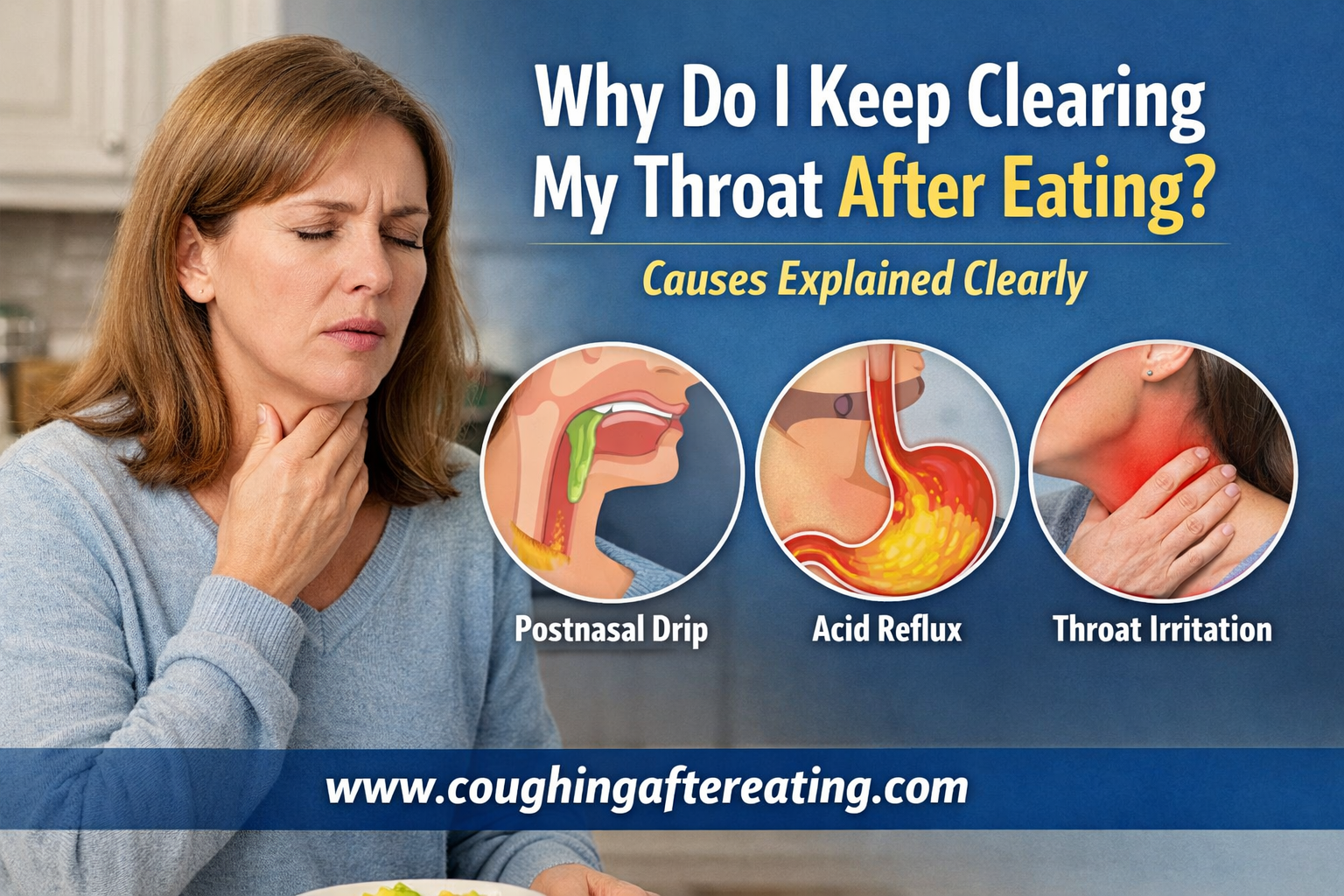
Why do I keep clearing my throat after eating? Causes explained clearly
Clearing your throat after eating can seem like a small habit, but when it happens often, it usually points to an underlying cause. Many people notice a repeated urge to clear their throat shortly after meals, especially after certain foods or eating patterns.
Throat clearing after eating is closely related to coughing after meals, but it usually reflects milder irritation rather than a strong airway reflex. Instead of a forceful cough, the body responds with repeated throat clearing to relieve irritation or clear mucus.
If you want to understand how this fits into the bigger picture, see the coughing after eating causes guide.
Clinically, throat clearing after eating is most often linked to reflux reaching the upper airway or increased mucus activity in the throat. Laryngopharyngeal reflux can irritate the throat even without classic heartburn, and postnasal drip can create the feeling of mucus collecting or trickling in the throat, both of which can trigger repeated clearing.
Mechanism:
Throat clearing after eating happens when mild irritation, mucus, or reflux affects the upper throat, triggering a repeated but less forceful protective reflex instead of a full cough.
What causes throat clearing after eating?
The urge to clear your throat after eating usually comes from irritation, mucus buildup, or a sensation that something is stuck in the throat. This can happen even when there is no actual blockage.
After eating, the throat and upper airway are exposed to food, temperature changes, and digestive responses. In some people, this increases throat sensitivity and leads to repeated throat clearing.
Unlike coughing, which is a stronger reflex that protects the airway, throat clearing is milder but often more persistent. It can continue because the irritation does not fully settle, creating a cycle where clearing the throat gives brief relief but does not remove the underlying cause.
Timing also matters. Symptoms that begin immediately may be linked to swallowing or direct irritation, while symptoms that appear gradually after eating are more often linked to reflux or mucus-related causes.
If you notice a regular pattern after meals, that consistency itself is one of the strongest clues to the cause.
Quick pattern signals:
- If it feels wet or phlegmy → think mucus or postnasal drip
- If it feels dry or scratchy → think irritation or dehydration
- If it appears after meals or lying down → think reflux
- If it happens immediately → think swallowing or direct irritation
Common causes of throat clearing after eating
Throat clearing after eating usually follows a pattern linked to timing, food triggers, throat sensations, and whether symptoms feel wet, dry, immediate, or delayed.
This becomes more suggestive of an underlying cause if the throat clearing appears at a consistent time after eating or happens repeatedly with the same foods or situations.
Acid reflux and throat irritation
One of the most common causes is acid reflux. When stomach contents move upward into the esophagus, small amounts may reach the throat and irritate its lining.
This does not always cause heartburn. In many people, it shows up mainly as throat symptoms such as clearing, hoarseness, or a sensation of mucus. This upper-throat pattern is often discussed in relation to laryngopharyngeal reflux, where even relatively small amounts of reflux can irritate sensitive throat tissues.
This pattern is especially common in silent reflux coughing after eating, where throat symptoms are more noticeable than chest symptoms.
If reflux is affecting the throat more generally, you can also explore can acid reflux cause coughing after eating. For a deeper explanation of the mechanism, see why GERD causes coughing after eating.
This is more likely if throat clearing happens after meals, when lying down, or after larger, heavier, spicy, or acidic foods.
Postnasal drip and mucus buildup
Another frequent cause is postnasal drip. This happens when excess mucus from the nose or sinuses drains down the back of the throat, especially after eating.
Certain foods, temperature changes, or even the act of chewing can make mucus more noticeable. When mucus collects in the throat, it often creates the urge to clear it repeatedly.
This type of throat clearing often feels wet or phlegmy and may be more noticeable after dairy, cold drinks, or spicy foods. Postnasal drip is well recognised as a cause of throat tickling, mucus sensation, and chronic cough-type symptoms, which is why it can overlap so closely with throat clearing after meals.
For a related explanation, see postnasal drip and coughing after eating.
This pattern is more likely if throat clearing feels wet, frequent, and comes with a sensation of mucus sitting in the throat.
Food sensitivities and irritation
Some people notice throat clearing after specific foods that irritate the throat lining or trigger a mild sensitivity response.
Common triggers include:
- Spicy foods
- Acidic foods such as citrus or tomatoes
- Dairy in some individuals
- Processed or heavily seasoned meals
These foods may not cause a full allergic reaction, but they can still increase mucus production or throat sensitivity.
Over time, this can create a predictable pattern after certain meals. If you notice this happening, reviewing foods that cause coughing after eating can help you identify likely triggers.
This is more likely if symptoms occur consistently after the same foods and improve when those foods are reduced or avoided.
Dry throat and dehydration
Sometimes the problem is not excess mucus but the opposite. A dry throat can also trigger the urge to clear it.
Eating dry foods, not drinking enough fluids, or speaking while eating can dry the throat lining and create a scratchy sensation.
Unlike mucus-related causes, this pattern often feels more like dryness or roughness than blockage.
If your symptoms are more noticeable around drinks or hydration, see why do I cough after drinking liquids for a related pattern and explanation.
This is more likely if the throat feels dry or scratchy rather than wet or blocked, especially with dry foods or low fluid intake.
These causes often overlap, which is why throat clearing after eating can feel persistent rather than occasional. This is why throat clearing can sometimes appear alongside coughing after eating, rather than as a completely separate symptom.
In some cases, repeated throat clearing may also overlap with aspiration when eating and coughing, particularly if tiny amounts of material are entering the airway. Aspiration refers to food, liquid, or other material entering the airway instead of going down the food pipe, and even minor events can trigger protective throat symptoms.
Throat clearing vs coughing after eating
Throat clearing and coughing are related, but they are not exactly the same.
Throat clearing is usually a mild, repetitive action aimed at relieving irritation or removing mucus from the upper throat. It is less forceful, but it can happen again and again.
Coughing is a stronger reflex that helps clear the lower airway. It is more likely when the body senses something that needs to be expelled more urgently.
If your symptoms include both throat clearing and coughing, it may help to compare them with wet vs dry cough after eating: what it means, since cough type can add another clue.
How throat clearing patterns differ from other causes of coughing after eating
Throat clearing after eating is closely related to coughing, but it usually follows a milder and more repetitive pattern.
Compared with reflux-related coughing
Unlike why GERD causes coughing after eating or silent reflux coughing after eating, where irritation may trigger more obvious coughing episodes, throat clearing often feels like a repeated need to clear the upper throat rather than a sudden cough.
Compared with immediate swallowing-related coughing
Compared with why do I cough immediately after eating, throat clearing is less often a single immediate reaction. It usually builds gradually and may continue for some time after the meal.
Compared with wet or dry cough patterns
It also differs from wet vs dry cough after eating: what it means, because throat clearing does not always involve a full cough or clear mucus production. The sensation is often more about irritation, roughness, or something lingering in the throat.
How throat clearing overlaps with other causes
It can overlap with postnasal drip and coughing after eating, but throat clearing after meals is often more directly tied to reflux, food irritation, or upper-throat sensitivity.
How to interpret throat clearing patterns
Recognising these differences helps you tell apart a mild irritation pattern from symptoms that may point to a more specific underlying cause.
In general, gradual and persistent throat clearing points more toward irritation or mucus, while sudden symptoms during eating point more toward swallowing-related triggers.
If your symptoms do not clearly fit one pattern, comparing them with the coughing after eating causes guide can help narrow things down.
When throat clearing after eating is a concern
In many cases, throat clearing after eating is harmless and related to mild irritation. However, some patterns deserve more attention.
You should pay closer attention if:
- The symptom is persistent or worsening
- It is accompanied by hoarseness or voice changes
- You have difficulty swallowing
- You feel food sticking in the throat
- It occurs along with frequent coughing
These signs may suggest ongoing irritation, reflux, or swallowing-related problems that need further evaluation. A lump or stuck sensation without true blockage can also overlap with globus sensation, which is commonly associated with reflux and postnasal drip rather than an actual obstruction.
If you are unsure whether your symptoms are mild or more serious, see when coughing after eating is serious for a broader view of warning signs.
How to reduce throat clearing after eating
In most cases, improvement depends on identifying whether reflux, mucus, or dryness is the dominant trigger. Reducing throat clearing after eating depends on the trigger. In most cases, the goal is to reduce reflux, mucus buildup, or throat dryness.
Eating slowly and chewing thoroughly can reduce irritation and make swallowing smoother. Rushing meals increases the chance of both throat sensitivity and reflux.
Staying well hydrated also helps. Water keeps the throat lining moist and may reduce both dryness and thick mucus.
You may also improve symptoms by identifying and avoiding specific trigger foods. If certain meals repeatedly lead to throat clearing, that pattern is worth paying attention to.
Posture matters as well. Remaining upright after eating helps reduce reflux and lowers the chance of throat irritation.
If symptoms improve when you slow down, stay upright, hydrate well, or avoid specific foods, that is a useful sign that the cause is reflux, irritation, or mucus-related rather than random.
If symptoms do not improve, or keep returning in the same pattern, it may be worth comparing them with the coughing after eating causes guide or a more specific post in your cluster.
Why throat clearing becomes a habit
In some people, throat clearing becomes habitual rather than purely symptom-driven.
Repeated clearing irritates the throat lining and increases sensitivity. Over time, the urge returns more easily, even when the original trigger has reduced.
This creates a self-reinforcing cycle where irritation leads to clearing, and clearing prolongs the irritation.
Breaking this cycle usually means reducing both the trigger and the throat-clearing habit itself.
This pattern is well recognised in throat and voice conditions, where repeated clearing can make the larynx more reactive over time.
Final takeaway
Throat clearing after eating usually reflects mild irritation, mucus buildup, or reflux affecting the throat. Although it may seem minor, it often follows the same patterns that cause coughing after meals.
The key is pattern recognition. Gradual and persistent throat clearing often points toward reflux or mucus-related irritation, while food-specific or dry sensations may suggest other triggers.
If your symptoms keep returning after the same foods, at the same time after meals, or in the same general pattern, that repeatability is an important clue.
If you are unsure what is causing your symptoms, reviewing the full coughing after eating causes guide can help you connect your experience to the right underlying cause.
What people ask about throat clearing after eating
These common questions help clarify why throat clearing happens after eating, how it differs from coughing, and which patterns matter most.
Why do I keep clearing my throat after eating?
Throat clearing after eating is usually caused by throat irritation, mucus activity, or a lingering sensation in the throat.
This is more likely if you feel something stuck, wet, dry, or irritating in the throat after meals and notice the same pattern repeatedly.
It is often linked to reflux, mucus buildup, or upper-airway sensitivity.
Is throat clearing after eating the same as coughing?
Not exactly. Throat clearing is a milder reflex used to relieve irritation or remove mucus from the upper throat, while coughing is a stronger reflex that clears the airway.
However, both can come from similar triggers and sometimes overlap.
Why do I feel mucus in my throat after eating?
A sensation of mucus after eating is often due to increased mucus production or increased awareness of mucus already present in the throat.
This is more likely if the feeling is wet or phlegmy after meals and you keep wanting to clear your throat.
It often overlaps with patterns described in wet vs dry cough after eating: what it means.
Can acid reflux cause throat clearing after eating?
Yes. Reflux can irritate the throat and trigger repeated throat clearing after meals.
This is more likely if symptoms appear after eating, worsen when lying down, or come with a dry, tickly throat.
This often overlaps with silent reflux coughing after eating.
Why do I clear my throat after eating but do not cough?
This usually happens when the irritation is mild or limited to the upper throat rather than strong enough to trigger a full cough.
It is more likely when the sensation feels subtle but persistent.
Is throat clearing after eating serious?
Occasional throat clearing is usually harmless. It becomes more important when it happens frequently, follows a clear pattern, or is getting worse over time.
Persistent symptoms may suggest reflux, mucus-related irritation, or throat sensitivity.
Does timing help identify the cause?
Yes. Timing gives useful clues.
Immediate throat clearing may point to swallowing or food irritation. Delayed throat clearing more often points to reflux. Ongoing throat clearing with a wet sensation suggests mucus involvement.
What should I do if I keep clearing my throat after eating?
If it happens regularly, the key is to identify patterns rather than ignore the symptom.
Reviewing the coughing after eating causes guide can help you decide whether reflux, mucus, dryness, or another trigger is more likely.