
Coughing after eating: causes, symptoms, triggers, and when it may be serious
Coughing after eating is a common symptom that can range from a brief, harmless irritation to a recurring pattern that raises concern. Some people notice it occasionally after certain meals, while others experience it more regularly as a pattern.
Although it may seem straightforward, coughing after meals can involve multiple systems working together, including the throat, airway, and digestive system. A change or imbalance in any one of these can trigger a cough, especially during or after eating.
This guide brings together the full picture of coughing after eating, including causes, patterns, triggers, and warning signs. By understanding how these elements interact, it becomes much easier to interpret your symptoms and decide what to do next.
Understanding the pattern behind your symptoms is key. You can explore the full range of causes in the coughing after eating causes guide, learn how to manage triggers in how to prevent coughing after eating, and understand how symptoms vary across different situations in coughing after eating in different situations.
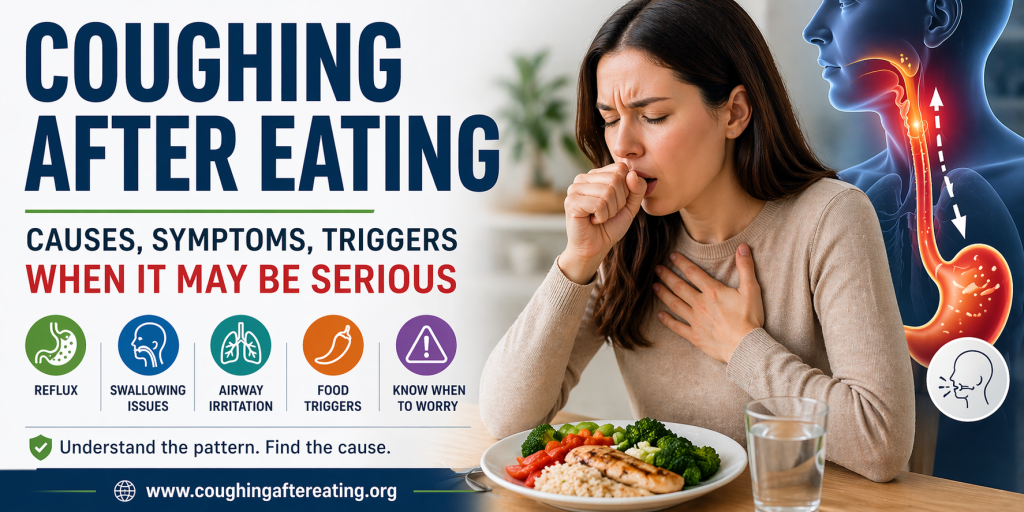
What coughing after eating means
Coughing after eating, sometimes described as a cough after meals or a cough triggered by eating, is not a condition by itself but a symptom that reflects how the body responds during or after food intake. It can arise from irritation in the throat, changes in airway sensitivity, or digestive processes that affect the upper airway.
For some individuals, the cough happens when food briefly irritates the throat or touches sensitive areas. In others, it becomes a consistent pattern that appears after most meals or with specific foods, suggesting a more persistent underlying mechanism.
This symptom sits at the intersection of the digestive system, respiratory system, and throat. Because of this overlap, similar symptoms can have very different causes, which is why observing patterns becomes more useful than focusing on the cough alone.
Coughing after eating refers to a cough that occurs during or after meals due to irritation in the throat, airway, or digestive system. It is a symptom rather than a condition and can be associated with reflux, swallowing issues, or airway sensitivity.
Understanding what this symptom represents is the first step in identifying whether it is occasional and harmless or part of a pattern that needs closer attention.
Why coughing after eating happens (quick answer)
Coughing after eating usually happens when food, liquid, or stomach contents irritate the throat or airway, triggering the cough reflex as a protective response. This reflex helps prevent material from entering the airway and keeps breathing pathways clear.
The most common reasons include reflux reaching the throat, swallowing difficulties, mucus buildup, or increased throat sensitivity. When coughing happens during eating, it often points to swallowing or airway protection. When it appears later, it is more commonly linked to reflux or digestion.
This quick explanation provides a simple framework that helps make sense of the more detailed patterns and causes explained below.
A deeper pattern check to understand your symptoms
Before going deeper, it helps to identify which general pattern your symptoms follow. Recognising these patterns early can make it much easier to connect your experience to the most likely cause and avoid unnecessary confusion.
Look for your pattern:
- Cough within seconds of eating often points to swallowing or airway protection. You can explore this pattern further in why do I cough immediately after eating.
- Cough a few minutes later is more often linked to reflux or digestion
- Wet or mucus producing cough suggests airway or mucus involvement
- Dry, irritating cough is often linked to reflux or throat sensitivity
- Cough triggered by specific foods points toward food sensitivity or irritation
- Inconsistent or mixed pattern may reflect cough reflex sensitivity
These distinctions are often used to understand whether a cough after eating is more likely due to reflux, swallowing issues, or airway sensitivity. If you are unsure where your symptoms fit, start with the coughing after eating causes guide to understand the overall pattern.
Taking a moment to identify your pattern early makes the rest of this guide easier to interpret. It provides a simple framework that helps connect symptoms to causes in a structured way.
Common causes of coughing after eating
Once you recognise your pattern, the next step is understanding what could be causing it. Coughing after eating can arise from several categories of causes, and in many cases more than one factor may be involved at the same time.
Most common causes of coughing after eating
Coughing after eating can arise from a range of underlying causes, but most fall into a few common patterns related to how the body handles swallowing, digestion, and airway protection.
The most frequently seen causes include:
- Acid reflux and silent reflux
- Swallowing difficulties such as dysphagia
- Aspiration of food or liquid into the airway
- Postnasal drip and mucus buildup
- Food sensitivities or irritation
- Airway conditions such as asthma
- Increased cough reflex sensitivity
These causes may appear separately, but in many people they overlap, which is why symptoms can feel inconsistent or difficult to interpret at first.
Reflux related causes
Reflux is one of the most common contributors to coughing after eating. It occurs when stomach contents move upward and cause irritation in the oesophagus or throat, sometimes reaching the voice box.
This includes gastroesophageal reflux and laryngopharyngeal reflux, where reflux reaches the throat without typical heartburn symptoms. This irritation can activate the cough reflex, especially after meals or when lying down.
You can explore this further in acid reflux and coughing after eating and silent reflux coughing after eating.
Swallowing related causes
Swallowing is a coordinated process involving multiple muscles and reflexes. If this coordination is disrupted, food or liquid may briefly enter the airway instead of moving smoothly into the oesophagus.
This reflects a breakdown in normal swallowing coordination and airway protection. The body responds immediately with a cough to clear the airway.
Conditions such as dysphagia or aspiration can cause this type of pattern. For more detail, these patterns are explained in dysphagia and coughing after eating and aspiration when eating why you cough.
Airway and mucus related causes
In some cases, coughing after eating is related to how the airway responds rather than digestion itself. Mucus may collect in the throat due to postnasal drip, or the airway may become more sensitive due to underlying conditions.
This increased sensitivity can make the cough reflex easier to trigger, even with mild irritation from food or temperature changes.
You can explore this further in postnasal drip and coughing after eating.
Food related causes
Certain foods can trigger coughing by irritating the throat or increasing sensitivity. This may include spicy foods, acidic foods, or specific ingredients that the body reacts to.
In most cases, this is not a severe allergy but a mild sensitivity that becomes noticeable during or after eating.
Cough reflex sensitivity
In some individuals, the cough reflex becomes more sensitive over time. Even small amounts of irritation can trigger coughing after meals, especially when combined with other underlying factors.
Coughing after eating is often the result of one or more of these causes interacting together rather than a single isolated issue. For a more detailed explanation of how each cause leads to coughing after eating, this is explained in the coughing after eating causes guide. Understanding these categories helps narrow down the possibilities and provides a clearer path toward identifying the most likely explanation.
Eating situations that trigger coughing
In many cases, the way you eat matters just as much as what you eat. Everyday habits and meal patterns can influence how your body responds during and after eating, especially when there is an underlying sensitivity. These patterns are explained in coughing after eating in different situations, including how posture, timing, and habits influence symptoms.
These situations may seem minor, but they can significantly affect how smoothly the swallowing process works and how much strain is placed on the throat and digestive system during meals.
Often, these triggers do not cause coughing on their own, but they lower the threshold at which irritation leads to a cough. This is why the same person may cough in certain situations but not others, even when eating similar foods.
Eating too quickly
Eating quickly reduces the time your body has to properly coordinate chewing and swallowing.
When food is swallowed before it is fully prepared, it can pass through the throat less smoothly, increasing the chance of irritation or brief airway entry. This overlaps with swallowing-related causes such as dysphagia and coughing after eating, where coordination is affected.
This pattern is more likely if coughing starts during the meal or immediately after swallowing, particularly when you are distracted or in a hurry.
Large or heavy meals
Large meals place more pressure on the stomach and can slow down digestion.
As the stomach fills and stretches, the likelihood of reflux increases, even in people who do not have chronic reflux symptoms. This is closely related to patterns explained in acid reflux and coughing after eating.
This pattern is more likely if coughing appears later after eating, especially after heavier or richer meals.
Lying down soon after eating
When you lie down, gravity no longer helps keep stomach contents in place.
This makes it easier for acid or partially digested food to move upward toward the throat, where it can irritate the airway and trigger a cough reflex. In some people this appears as silent reflux coughing after eating, where typical heartburn is not obvious.
This is one of the most consistent situational triggers and is more likely if coughing happens shortly after meals when resting or going to bed.
Talking while eating
Talking disrupts the normal rhythm of swallowing and breathing.
Swallowing is a precisely timed process that briefly closes the airway. When you talk while eating, this coordination can be disturbed, increasing the chance that small amounts of food or liquid enter the airway. In some cases, this can resemble patterns explained in aspiration when eating why you cough.
This pattern is more likely if coughing happens mid-meal, especially during conversation.
Drinking liquids too quickly
Drinking quickly can overwhelm swallowing coordination, particularly with thin liquids.
Liquids move faster than solid food and require precise timing to prevent airway entry. In sensitive individuals, rapid drinking can trigger coughing even when swallowing function is otherwise normal. If this happens mainly with drinks, this is explained in why do I cough after drinking liquids.
This is more likely if coughing happens with water or drinks rather than solid food, or when drinking in large gulps.
Quick pattern check: why certain eating habits trigger coughing
A quick way to narrow this down is to look at when and how the cough happens:
If your coughing after eating is inconsistent, the situation around the meal often gives important clues. These common patterns can help you identify what is triggering your symptoms.
- Coughing during or immediately after eating → Often linked to swallowing coordination or airway irritation, as explained in dysphagia and coughing after eating
- Coughing after large or heavy meals → More likely related to digestion and stomach pressure, as explained in acid reflux and coughing after eating
- Coughing after lying down post-meal → Suggests reflux reaching the throat, sometimes without heartburn, as explained in silent reflux coughing after eating
- Coughing while talking and eating → Points to disrupted swallowing timing or possible airway entry, as explained in aspiration when eating why you cough
- Coughing mainly when drinking liquids → Often related to liquid swallowing coordination, as explained in why do I cough after drinking liquids
- Coughing within seconds vs later after eating → Timing helps separate swallowing causes from reflux-related causes, as explained in why do I cough immediately after eating
Understanding these patterns can help narrow down the cause more quickly and guide what to adjust first, whether that is eating habits, meal size, or further evaluation.
When these habits are adjusted, many people notice a reduction in symptoms even without changing diet or treating an underlying condition directly.
These situational triggers often combine with underlying causes rather than acting alone. If your cough follows a clear timing pattern, it can help narrow down the cause, whether it is why do I cough immediately after eating or a delayed reflux-related response. Understanding whether your cough is wet or dry can also help guide this, as explained in wet vs dry cough after eating: what it means.
Recognising and adjusting these habits can significantly reduce symptoms and also help reveal whether a deeper issue, such as reflux or swallowing difficulty, is present.
These patterns are explained further in coughing after eating in different situations, including how posture, meal size, and eating speed influence symptoms.
Food triggers to watch for
Some triggers are not obvious until you start paying attention to specific foods and how your body responds to them. Identifying these patterns can play a key role in reducing symptoms over time.
These triggers do not affect everyone in the same way, but they often act by increasing irritation, sensitivity, or reflux, making the throat more reactive during or after eating. A more detailed breakdown of these triggers is covered in foods that cause coughing after eating.
In most cases, these foods do not directly cause the problem but lower the threshold for coughing, especially when combined with factors like reflux, airway sensitivity, or mild swallowing difficulty.
Spicy and acidic foods
Spicy and acidic foods can irritate the lining of the throat while also increasing acid activity in the stomach. This combination makes the airway more sensitive and increases the likelihood of reflux reaching the throat.
This is more likely if coughing appears after meals rather than during them, especially with citrus, tomato-based dishes, or heavily spiced foods. This pattern often overlaps with acid reflux and coughing after eating.
Dairy products in some individuals
Dairy does not affect everyone the same way, but in some individuals it can make mucus feel thicker or more noticeable in the throat. This can create a sensation of coating or heaviness, leading to more frequent throat clearing or mild coughing after meals.
This is more likely if symptoms include mucus sensation or repeated throat clearing rather than sharp irritation. It can overlap with patterns explained in postnasal drip and coughing after eating.
Dry or crumbly foods
Dry foods such as crackers, toast, or crumbly snacks can be more difficult to swallow smoothly, particularly if there is even mild coordination difficulty. Small particles may linger in the throat or require extra effort to clear, increasing irritation during eating.
This is more likely if coughing occurs during meals rather than after, especially with dry textures. This pattern can overlap with dysphagia and coughing after eating.
Very hot or very cold foods
Extreme temperatures can stimulate sensitive nerve endings in the throat, even without causing visible irritation. In people with heightened airway sensitivity, this can trigger a cough reflex almost immediately.
This is more likely if coughing happens right as the food or drink is consumed, rather than later. It often fits into broader patterns of cough reflex sensitivity after eating.
Known allergens
Certain foods can trigger mild allergic or sensitivity responses that affect the throat and airway. Even when reactions are not severe, they can cause subtle irritation, increased sensitivity, or mild swelling that makes coughing more likely.
This is more likely if symptoms are consistent with specific foods and may include throat discomfort, itching, or a persistent urge to cough. This pattern is sometimes seen in food allergies and coughing after eating.
Keeping track of which foods consistently trigger symptoms can help create a simple and effective strategy for reducing coughing without unnecessary restrictions.
Food triggers vary widely between individuals, so observing your own responses over time is more effective than broadly avoiding foods without clear patterns. Understanding whether your cough relates more to food type, timing, or texture can also help connect it to patterns explained in wet vs dry cough after eating: what it means.
A personalised approach allows you to make targeted adjustments while still maintaining a balanced and practical diet.
Symptoms and patterns to notice
The details of how your cough behaves often provide the most useful clues about its underlying cause. Paying attention to timing, triggers, and associated sensations can help narrow down possibilities more effectively.
Rather than focusing on a single symptom, looking at patterns allows you to connect your experience to the most likely mechanism involved. A broader approach to managing these patterns in daily life is explained in how to prevent coughing after eating.
In some cases, symptoms may also change depending on how and where you eat, including posture, speed, and meal size, which are explored further in coughing after eating in different situations.
Quick pattern check: what your cough timing and triggers may mean
- Coughing during eating → often points to swallowing coordination or airway protection, as discussed in dysphagia and coughing after eating
- Coughing immediately after eating → often points to throat irritation, sensitivity, or a swallowing-phase trigger, as explained in why do I cough immediately after eating
- Coughing several minutes later → more often points toward reflux or digestion-related irritation, as described in acid reflux and coughing after eating
- Wet cough after eating → may suggest mucus or airway involvement, as explained in wet vs dry cough after eating
- Frequent throat clearing after eating → may suggest mucus, postnasal drip, or ongoing throat irritation, as seen in why do I keep clearing my throat after eating
- Coughing mainly with liquids → may point toward liquid-swallowing coordination issues, as discussed in why do I cough after drinking liquids
How to interpret your cough pattern after eating
The most effective way to understand what is causing your cough after eating is to look at patterns rather than focusing on a single episode. A one-off cough can happen for many reasons, but repeated patterns often reveal what is actually driving the symptom.
Start by paying attention to when the cough happens. If it occurs during eating or within seconds of swallowing, it is more likely related to airway protection or swallowing, as explained in why do I cough immediately after eating. If it begins several minutes later, it is more often linked to digestion or reflux, which is explored in acid reflux and coughing after eating. This difference in timing is one of the most useful clues in narrowing down the cause.
Next, consider what seems to trigger the cough. If coughing happens mainly with liquids, it may point to swallowing coordination, as discussed in why do I cough after drinking liquids. If it is linked to certain foods, irritation or sensitivity may be playing a role, as explained in foods that cause coughing after eating. If the pattern is mixed or depends on how or where you eat, it often reflects a broader sensitivity pattern rather than a single cause.
It also helps to notice what the cough feels like. A dry, irritating cough may suggest throat irritation or reflux, while a wet or mucus-producing cough may involve airway or mucus interaction, as explained in wet vs dry cough after eating. This adds another layer of clarity when timing and triggers are not obvious.
Finally, look at how often the cough happens and whether it is changing over time. Occasional coughing is usually not concerning, but frequent, worsening, or persistent patterns deserve closer attention. In these situations, it is important to review when coughing after eating is serious so that more significant causes are not overlooked.
If you want a structured way to connect these patterns to possible causes, start with the coughing after eating causes guide, then explore ways to reduce triggers in the how to prevent coughing after eating guide. Once the pattern becomes clear, the next step is usually much easier to decide.
What timing of coughing after eating means
The timing of your cough is one of the most useful clues in understanding what may be causing it. Even small differences in when the cough appears can point toward very different underlying mechanisms.
Coughing during eating or within seconds of swallowing usually points to swallowing coordination or airway protection. In contrast, coughing that appears several minutes later is more often linked to reflux or digestion-related irritation.
These distinctions are especially helpful when symptoms seem inconsistent, as timing can reveal patterns that are not obvious when looking at food triggers alone.
Once you recognise whether your cough happens immediately or after a delay, the next step is to reduce triggers and improve eating habits using strategies in how to prevent coughing after eating.
Immediate vs delayed coughing
If coughing happens during eating or within seconds of swallowing, it usually reflects a swallowing-phase trigger, where food or liquid briefly irritates the airway. This type of cough tends to feel immediate and closely linked to the act of eating itself. Explore this further in why do I cough immediately after eating.
If coughing occurs later, particularly several minutes after a meal, reflux becomes a more likely explanation. This delayed pattern reflects irritation that develops after digestion has begun rather than during swallowing.
Understanding this timing difference helps narrow down the cause, and the next step is to apply practical adjustments from the how to prevent coughing after eating guide.
Wet vs dry cough
A wet cough usually suggests the presence of mucus or airway involvement, while a dry cough is more often linked to irritation, reflux, or heightened sensitivity. The sound and sensation of the cough can therefore provide an additional layer of useful information.
This distinction becomes more meaningful when combined with timing and triggers rather than viewed in isolation. A deeper explanation is provided in wet vs dry cough after eating: what it means.
Cough with throat clearing
Frequent throat clearing after meals can indicate mucus buildup, postnasal drip, or ongoing throat irritation. Because it is milder than a strong cough, it is often overlooked even when it happens regularly.
When persistent, this pattern can point toward underlying sensitivity or mucus-related causes rather than a one-time irritation. You can explore this further in why do I keep clearing my throat after eating.
Cough triggered by liquids
Coughing that occurs mainly when drinking liquids often points toward coordination or sensitivity issues in the swallowing process. Liquids move quickly through the throat and require precise timing to prevent airway entry.
This pattern is particularly useful in narrowing down swallowing-related causes, especially when solid foods do not trigger symptoms, as explained in why do I cough after drinking liquids.
Looking at these patterns together provides a clearer and more complete understanding than focusing on a single symptom. It helps connect your experience with the most likely underlying cause in a structured and practical way.
Recognising these patterns not only helps identify the likely cause but also points toward practical changes in eating habits and triggers explained in how to prevent coughing after eating.
How to reduce or prevent coughing after eating
In many cases, simple changes can significantly reduce coughing after meals. These changes focus on improving how the body handles food during and after eating, rather than relying on complex interventions.
These adjustments work by reducing irritation, improving coordination during swallowing, and minimising the chances of reflux reaching the throat.
Eating slowly and chewing thoroughly helps maintain proper swallowing coordination. Avoiding large meals reduces pressure on the stomach and lowers the chance of reflux.
Remaining upright after eating supports normal digestion and reduces irritation. Identifying and avoiding trigger foods can prevent repeated symptoms and make patterns easier to manage.
Over time, these small changes can make a noticeable difference, especially when applied consistently across meals.
These steps are often enough for mild cases. However, if symptoms persist despite these adjustments, it may indicate the need for further evaluation.
When coughing after eating may be serious
In most cases, coughing after eating is not serious. However, certain patterns should not be ignored, especially if they become frequent or start to interfere with eating or daily comfort.
If coughing is associated with choking, difficulty swallowing, unexplained weight loss, or repeated chest infections, it may indicate a more serious issue that needs medical attention.
You can explore these in detail in when coughing after eating is serious.
Recognising these warning signs early helps ensure that more serious conditions are identified and addressed in time.
Pattern quick-check
- Cough during eating → often linked to swallowing coordination or airway protection, as explained in dysphagia and coughing after eating
- Cough within seconds after eating → often linked to swallowing or airway protection, as explained in why do I cough immediately after eating
- Cough several minutes later → more often linked to reflux or digestion-related irritation, as explained in acid reflux and coughing after eating
- Cough mainly with liquids → often linked to liquid swallowing coordination, as explained in why do I cough after drinking liquids
Final takeaway
Coughing after eating is not random. It usually follows a pattern linked to how your body responds during swallowing, digestion, throat sensitivity, reflux, or airway protection.
The most useful clue is not the cough alone, but when it happens and what comes with it. A cough during eating may point toward swallowing or airway protection, as explained in why do I cough immediately after eating. A cough several minutes later may suggest reflux or digestive irritation, as explained in acid reflux and coughing after eating. A cough linked to liquids may point toward swallowing coordination, as explained in why do I cough after drinking liquids. If symptoms persist, worsen, or feel unusual, it is important to review when coughing after eating is serious.
Patterns matter more than one-off episodes. If the timing is consistent, the underlying cause is usually consistent too. That is what makes this symptom easier to understand once you start observing it clearly.
Instead of guessing, use the pattern you notice to guide your next step. Start with the coughing after eating causes guide to understand the full picture, then explore practical changes in how to prevent coughing after eating, review common triggers in foods that cause coughing after eating, and follow the path that best matches your symptoms.
Frequently asked questions about coughing after eating
Many people experience coughing after meals at some point, and it often raises similar questions about causes, timing, patterns, and when to seek help. The answers below are arranged to help you move from general understanding to more specific patterns, so you can recognise what your symptoms might mean.
Is it normal to cough after eating?
Occasional coughing after eating can be normal, especially if food or liquid briefly irritates the throat or goes down the wrong way. The body uses coughing as a protective reflex to clear the airway.
However, if coughing happens regularly, follows a clear pattern, or is triggered by specific foods or timing, it usually points to an underlying cause rather than a one-off event. In those cases, it helps to look more closely at patterns using the coughing after eating causes guide.
How do I figure out what is causing my cough after eating?
The most useful way to understand the cause is to look at patterns in your symptoms rather than focusing on a single episode. The timing of the cough, what triggers it, and whether it feels dry or mucus-related can all provide important clues.
For example, coughing during or immediately after eating is often linked to swallowing or airway protection, while coughing that starts later is more often related to reflux or digestion. Triggers such as liquids, specific foods, or mixed patterns can also help narrow down the cause.
You can explore these patterns in more detail in why do I cough immediately after eating, acid reflux and coughing after eating, and wet vs dry cough after eating.
A complete structured approach is explained in the coughing after eating causes guide and how to prevent coughing after eating.
Why do I cough immediately after eating?
Coughing immediately after eating or within seconds of swallowing is usually related to how food or liquid is moving through the throat. This can happen if small amounts enter the airway or if the swallowing process is not fully coordinated.
This pattern is often linked to airway protection rather than digestion. If this happens frequently, especially with liquids or certain textures, it is worth exploring further in why do I cough immediately after eating.
Why do I cough a few minutes after eating?
Coughing that starts several minutes after eating is more commonly linked to reflux or digestion. In this case, stomach contents or irritation can move upward and trigger a cough reflex after the meal has begun to settle.
This type of cough often follows a consistent timing pattern and may be associated with throat irritation, a dry cough, or a need to clear the throat. You can explore this pattern in more detail in acid reflux and coughing after eating.
Why do I cough only when drinking water or liquids?
Coughing mainly when drinking liquids often points to how swallowing is coordinated rather than a digestion issue.
Liquids move more quickly than solid food, so even small coordination differences in swallowing can trigger coughing. This may happen if liquid briefly enters the airway or if the throat reacts more sensitively to fast flow.
If this pattern is consistent, especially with thin liquids like water, it is worth exploring in why do I cough after drinking liquids to understand possible causes and next steps.
Can certain foods cause coughing after eating?
Yes. A more detailed breakdown of common trigger foods is covered in foods that cause coughing after eating.
Common triggers include spicy foods, acidic foods, very hot or cold items, and sometimes dry or crumbly textures. If your cough seems linked to specific foods, it can help to observe patterns over time.
You may also find it helpful to look at simple adjustments in eating habits and timing in how to prevent coughing after eating.
Is a dry or wet cough after eating more important?
The type of cough can provide useful clues about what is happening in the airway.
A dry cough after eating is more often linked to irritation, reflux, or throat sensitivity. It may feel like a tickle or persistent urge to cough without bringing anything up.
A wet or productive cough, on the other hand, may suggest mucus involvement or that small amounts of food or liquid are interacting with the airway. This pattern can sometimes be associated with swallowing-related issues.
If you are unsure what your cough type means, comparing patterns can help. You can explore this further in wet vs dry cough after eating: what it means.
Why do I cough after eating but not during the meal?
If coughing happens after eating rather than during the meal, it usually suggests that the trigger is developing after swallowing is complete.
This pattern is commonly linked to reflux, where stomach contents or irritation affect the throat after a delay. It can also be influenced by posture, meal size, or how quickly you eat, which are explained further in coughing after eating in different situations.
Looking at when the cough starts and how consistently it follows meals can help narrow this down further.
When should I worry about coughing after eating?
Coughing after eating should be taken more seriously if it happens frequently, worsens over time, or is associated with symptoms such as choking, difficulty swallowing, chest discomfort, or unexplained weight loss.
It is also important to pay attention if the cough disrupts meals regularly or happens with most foods or drinks. These patterns may indicate an underlying issue that needs evaluation. You can review warning signs in when coughing after eating is serious to decide when to seek medical advice.
Coughing after eating becomes much easier to understand once you stop looking at it as a random symptom and start recognising patterns. Timing, triggers, and consistency often point more clearly to a cause than the cough itself. By observing these signals and following the relevant guides, you can move from uncertainty to a clearer and more confident next step.