
Coughing after eating treatment: Medical care, lifestyle changes and home remedies
Treatment for coughing after eating depends on identifying the underlying reason why symptoms occur. While some people improve with simple lifestyle changes or home remedies, others may require medical treatment for conditions such as reflux, swallowing disorders, allergies, or airway irritation. Because coughing after meals is a symptom rather than a condition itself rather than a condition itself, successful treatment usually focuses on addressing the underlying cause instead of simply trying to suppress the cough.
If you are still trying to understand why symptoms occur, it may help to first explore coughing after eating, the common causes of coughing after eating, the symptoms of coughing after eating, foods that trigger coughing after eating, situations that trigger coughing after eating, and coughing after eating patterns. Recognising these factors often makes it easier to understand which treatments are most likely to help. If the underlying cause remains uncertain, coughing after eating diagnosis can help identify the reason for your symptoms and guide appropriate treatment.
This guide explains the different approaches to coughing after eating treatment, including medical care, lifestyle changes and home remedies. It also discusses which treatments may help different underlying causes, when coughing after eating prevention strategies may reduce future episodes, and when medical assessment should be sought if symptoms persist, worsen, or are accompanied by other concerning features.
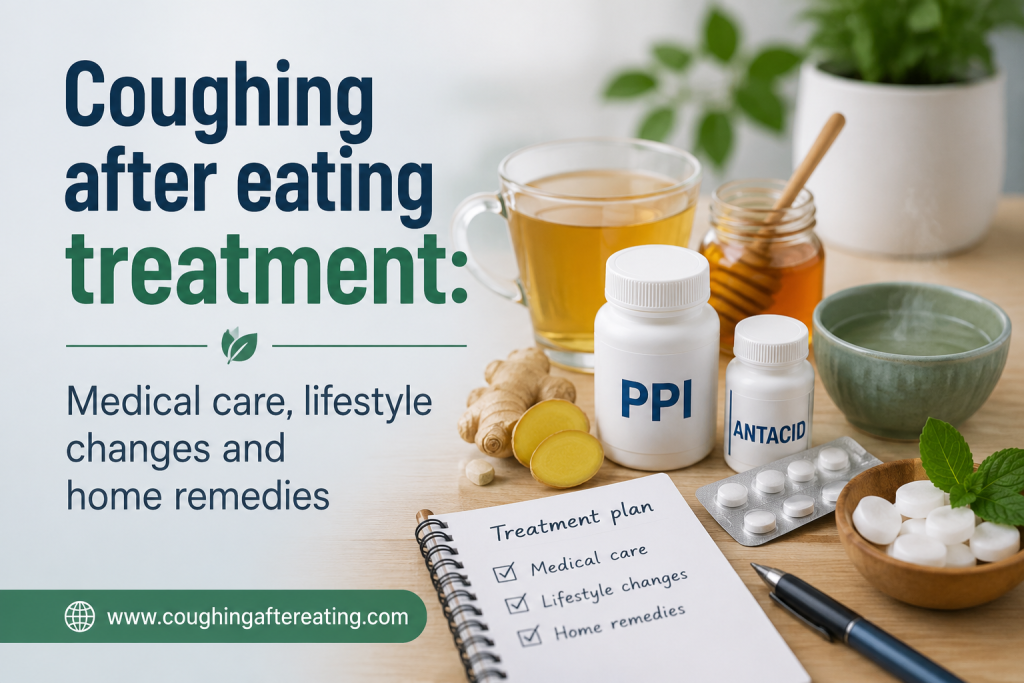
The most effective treatment for coughing after eating depends on the underlying cause and may include medical care, lifestyle changes, home remedies, or a combination of these treatments.
Understanding treatment for coughing after eating
Key point
There is no single treatment that works for everyone. Successful treatment depends on identifying and managing the underlying cause of coughing after eating rather than simply trying to suppress the cough.
Finding the right treatment for coughing after eating begins with understanding why the cough occurs. Because coughing after eating can develop for several different reasons, there is no single treatment that works for everyone. The most effective approach depends on identifying the underlying cause and selecting the management strategy most appropriate for your symptoms.
Whether you are looking for relief for coughing after eating or long term management of coughing after eating, successful treatment usually focuses on addressing the condition responsible for triggering the cough rather than simply suppressing it. Understanding this principle helps explain why different people benefit from different treatments and why an accurate diagnosis often plays an important role in achieving lasting improvement.
Why there is no single treatment
There is no universal answer to how to treat coughing after eating because the symptom may result from reflux, swallowing disorders, food allergies, airway irritation, or several contributing factors occurring together. This is why how coughing after eating is treated varies from person to person, even when symptoms appear similar.
Some individuals improve with lifestyle changes alone, while others require medication, swallowing therapy, or treatment for an underlying medical condition. Rather than looking for a single cure, treatment is usually tailored to the specific cause identified during assessment.
Treating the underlying cause rather than the cough
The most effective approaches to coughing after eating treatment focus on identifying and managing the condition responsible for the cough instead of simply masking symptoms. Treating the underlying cause of coughing after eating often provides more lasting improvement than relying on cough suppressants alone, particularly when symptoms are caused by reflux, swallowing difficulties, or other ongoing medical conditions.
As a result, managing coughing after eating may involve medical treatment, lifestyle measures, home remedies, or a combination of these approaches depending on the underlying diagnosis. Choosing treatment based on the cause rather than the symptom offers the best chance of reducing both the frequency and severity of coughing episodes over time.
Understanding the principles behind treatment for coughing after eating helps explain why no single approach works for everyone. The most appropriate treatment depends on the underlying cause and may involve medication, lifestyle measures, supportive home remedies, or a combination of these strategies.
The following sections explore the different medical options for coughing after eating, lifestyle approaches, and home remedies that may be recommended depending on the reason for your symptoms, helping you understand where each treatment may fit within an overall management plan.
Treatment principles at a glance
| Principle | Why it matters |
|---|---|
| Identify the underlying cause | Guides the most appropriate treatment. |
| Treat the underlying condition | Often provides better long term results than suppressing the cough. |
| Combine treatments when needed | Medical care, lifestyle changes and home remedies often work together. |
| Review treatment if symptoms persist | Persistent symptoms may require further assessment or a different approach. |
Medical treatment for coughing after eating
Medical treatment for coughing after eating may be recommended when symptoms are linked to an underlying medical condition rather than the cough itself. The aim of treatment is to identify and manage the condition responsible for triggering coughing after meals instead of simply suppressing the cough. Depending on the diagnosis, treatment may involve medication, specialist assessment, swallowing rehabilitation, or other targeted therapies.
The most appropriate medical options for coughing after eating vary according to the underlying cause. Some people require only short term treatment, while others benefit from ongoing management of chronic conditions. Understanding when medical treatment is needed for coughing after eating can help explain why different people receive different recommendations and why an accurate diagnosis often plays an important role in achieving lasting improvement.
Medications for coughing after eating
Several medications for coughing after eating may be recommended when symptoms are caused by an underlying medical condition. The medicines prescribed depend on the diagnosis rather than the cough itself. In many cases, medicine for coughing after eating is used to treat reflux, reduce inflammation, or manage another contributing condition instead of acting directly on the cough reflex.
Understanding how medications are used for coughing after eating helps explain why treatment varies between individuals. While some people improve with medication alone, others benefit from combining medicines with lifestyle measures or specialist therapies. If symptoms continue despite treatment, further assessment may be needed to review the diagnosis and determine whether medication can help coughing after eating more effectively.
Key points
- Medicines are chosen according to the underlying diagnosis.
- Treatment usually targets the cause rather than the cough itself.
- Medication is often combined with other treatment approaches.
- Persistent symptoms may require review or adjustment of treatment.
Treatments for reflux related coughing after eating
Treating acid reflux related coughing after eating is one of the most common medical approaches because reflux frequently contributes to coughing after meals. Depending on the type and severity of reflux, treatment may include PPIs for coughing after eating, antacids for coughing after eating, alginates for coughing after eating, together with broader reflux management for coughing after eating.
For many people, managing acid reflux to reduce coughing after eating helps decrease irritation affecting the throat and upper airway. When appropriate, combining medication with managing reflux to treat coughing after eating and practical lifestyle measures may provide better long term symptom control than relying on medication alone.
Reflux treatment options
- PPIs for coughing after eating
- Antacids for coughing after eating
- Alginates for coughing after eating
- Reflux management for coughing after eating
Swallowing and airway treatments
When swallowing difficulties contribute to symptoms, swallowing therapy for coughing after eating may help improve swallowing safety and reduce coughing during meals. Depending on the underlying problem, speech and language therapy for coughing after eating, swallowing rehabilitation for coughing after eating, and other therapy for swallowing problems after eating may be recommended following specialist assessment.
Treatment often focuses on improving swallowing function and reducing the chance of food or liquid entering the airway. In some situations, airway protection strategies for coughing after eating and protecting the airway while eating form an important part of management, particularly for people at increased risk of aspiration.
Swallowing therapy may help by
- Improving swallowing safety.
- Supporting safer eating.
- Reducing aspiration risk.
- Protecting the airway during meals.
Treating food allergies and sensitivities
If allergies are identified as the underlying cause, allergy management for coughing after eating usually involves avoiding confirmed trigger foods together with appropriate medical care. The most suitable allergy treatment for coughing after eating depends on the type of allergy, the severity of the reaction, and the individual’s overall medical history.
For some people, treating food allergies causing coughing after eating can significantly reduce or even prevent symptoms after meals. Identifying the correct trigger is important because treatment for allergies differs from the approaches used for reflux or swallowing disorders.
Allergy management may involve
- Identifying confirmed food allergens.
- Avoiding trigger foods.
- Following appropriate medical advice.
- Reviewing treatment if symptoms persist or change.
Medical treatment is most effective when it is guided by an accurate diagnosis and targeted towards the underlying cause of symptoms. While some people benefit from medication or specialist therapies, others require a combination of treatments that address different aspects of the condition. Regular review is also important, as treatment may need to be adjusted if symptoms persist, change over time, or do not respond as expected.
Medical treatment is often only one part of a broader management plan. Many people also benefit from lifestyle treatment for coughing after eating, which focuses on everyday habits that may reduce irritation and help prevent symptoms from recurring. The next section explores these practical lifestyle approaches and how they may complement medical treatment as part of long term symptom management.
Lifestyle treatment for coughing after eating
For many people, lifestyle treatment for coughing after eating forms an important part of an overall management plan. Practical day to day changes may help reduce irritation, improve swallowing, minimise reflux, and lower the likelihood of coughing after meals. These approaches are often recommended alongside medical treatment and, for some individuals with mild or occasional symptoms, may provide significant improvement on their own.
Many people find that treating coughing after eating with lifestyle changes works best when several measures are combined rather than relying on a single adjustment. The following sections explore common lifestyle approaches that may help reduce symptoms and support long term management of coughing after eating.
Daily habits and lifestyle changes
Simple routines can make a meaningful difference for some individuals. Daily habits to treat coughing after eating may include eating more slowly, chewing food thoroughly, remaining upright after meals, and avoiding behaviours that repeatedly trigger symptoms. For many people, lifestyle changes for coughing after eating become more effective when they are followed consistently over time rather than only when symptoms occur.
Understanding how lifestyle changes help coughing after eating can make it easier to identify which adjustments are most relevant to your own situation. While no single habit works for everyone, managing coughing after eating with lifestyle changes often involves developing practical routines that become part of everyday life.
Lifestyle measures may include
- Daily habits to treat coughing after eating.
- Lifestyle changes for coughing after eating.
- Eating more slowly and chewing food thoroughly.
- Remaining upright after meals.
- Avoiding situations that repeatedly trigger symptoms.
Dietary changes and meal timing
For some people, dietary changes for coughing after eating play an important role in reducing symptoms. This may involve reducing foods that worsen reflux, avoiding foods that are difficult to swallow, or identifying personal trigger foods. In many cases, diet treatment for coughing after eating is tailored to the individual’s symptoms rather than following a single eating plan.
Many people find that changing your diet to treat coughing after eating is most effective when combined with meal timing for coughing after eating. Changing meal timing to treat coughing after eating, such as avoiding large meals late in the evening and allowing sufficient time before lying down, may help reduce irritation and improve overall symptom control.
Dietary approaches may include
- Dietary changes for coughing after eating.
- Changing your diet to treat coughing after eating.
- Meal timing for coughing after eating.
- Changing meal timing to treat coughing after eating.
Weight management and long term lifestyle approaches
For some individuals, weight management for coughing after eating may help reduce factors that contribute to symptoms, particularly when reflux is involved. Where appropriate, losing weight to treat coughing after eating may form part of a broader treatment plan that supports digestive health and helps reduce repeated irritation after meals.
Rather than relying on a single change, many people benefit from natural lifestyle approaches for coughing after eating that combine healthy eating, appropriate meal timing, and consistent daily habits. Building sustainable routines often provides better long term management of coughing after eating than making short term changes that are difficult to maintain.
Long term lifestyle strategies
- Weight management for coughing after eating.
- Losing weight to treat coughing after eating.
- Natural lifestyle approaches for coughing after eating.
- Long term management of coughing after eating.
Although lifestyle treatment for coughing after eating may help reduce symptoms for many people, it is often most effective when combined with other appropriate treatments. Some individuals also find that supportive home remedies provide additional comfort alongside medical treatment and lifestyle measures.
The next section explores home remedies for coughing after eating, home treatment for coughing after eating, and other natural remedies for coughing after eating, explaining where these approaches may fit within an overall treatment plan.
Home remedies for coughing after eating
Many people look for home remedies for coughing after eating to help soothe throat irritation or improve comfort after meals. Although home treatment for coughing after eating and other forms of home care for coughing after eating may provide temporary relief for some individuals, these approaches are generally most effective when used alongside treatment for the underlying cause rather than as a replacement for appropriate medical care.
Many natural remedies for coughing after eating focus on soothing the throat or reducing irritation rather than treating the condition responsible for the cough. The following sections explore commonly used remedies, how they may help, and the situations in which they may or may not be appropriate.
Warm drinks and soothing remedies
Warm drinks and soothing foods are among the most commonly used natural remedies for coughing after eating, particularly when symptoms are related to throat irritation. Some people find that honey for coughing after eating, ginger for coughing after eating, warm water for coughing after eating, or herbal teas for coughing after eating help soothe the throat and improve comfort after meals.
The benefits of these remedies vary from person to person and depend on the underlying cause of the cough. While they may help relieve irritation for some individuals, they are generally intended to provide comfort rather than treat the medical condition responsible for ongoing symptoms.
Common soothing remedies
- Honey for coughing after eating.
- Ginger for coughing after eating.
- Warm water for coughing after eating.
- Herbal teas for coughing after eating.
Throat comfort measures
Some home remedies are designed to soothe an irritated throat rather than treat the underlying cause of coughing. Depending on the symptoms, steam for coughing after eating, salt water gargle for coughing after eating, and lozenges for coughing after eating may help improve comfort after meals.
These measures are usually best viewed as supportive treatments rather than long term solutions. If coughing continues, becomes more frequent, or is accompanied by swallowing difficulties or other concerning symptoms, further medical assessment may be needed to identify the underlying cause.
Throat comfort measures
- Steam for coughing after eating.
- Salt water gargle for coughing after eating.
- Lozenges for coughing after eating.
Popular remedies with limited evidence
Some remedies discussed online have limited scientific evidence or may not be appropriate for everyone. For example, apple cider vinegar for coughing after eating is sometimes suggested as a home remedy, but it may worsen symptoms in people whose cough is related to acid reflux or other digestive conditions.
Before trying any new remedy, it is important to consider the likely underlying cause of the cough and whether the approach is suitable for your situation. Even natural products can sometimes aggravate symptoms or interact with existing medical conditions, so they should be used thoughtfully rather than assumed to be universally beneficial.
Use caution with home remedies
- Apple cider vinegar for coughing after eating may not be suitable for everyone.
- Natural remedies may help relieve symptoms but do not treat every cause of coughing.
- Persistent or worsening symptoms should be medically assessed.
While home remedies for coughing after eating may help improve comfort for some people, they are not a substitute for identifying and treating the underlying cause of persistent symptoms. The greatest benefit is often achieved when supportive remedies are combined with appropriate medical treatment and practical lifestyle measures as part of an overall management plan.
The next section explains when professional assessment should be sought, helping you recognise when coughing after eating may require further investigation rather than continued home management.
When to seek medical advice for coughing after eating
Occasional coughing after eating is often short lived and may improve with simple measures. However, persistent, worsening, or recurrent symptoms should not be ignored. If symptoms continue despite treatment for coughing after eating, or you are still wondering what can I do about coughing after eating because everyday measures are no longer helping, medical assessment is recommended to identify the underlying cause.
Seeking medical advice is particularly important if coughing after meals is accompanied by difficulty swallowing, choking, unexplained weight loss, repeated chest infections, or other concerning features. Identifying the underlying cause allows treatment to be tailored to your individual situation and helps determine how coughing after eating is treated most effectively.
Persistent or worsening symptoms
Medical assessment should be considered if coughing after eating becomes more frequent, lasts for several weeks, or begins to interfere with eating, drinking, or everyday activities. People looking for options for persistent coughing after eating often require further investigation to determine whether an underlying condition is responsible and whether additional treatment is needed.
Finding the cause is usually the first step towards effective management. Understanding how to manage coughing after eating symptoms helps ensure that treatment is directed at the underlying condition rather than simply trying to suppress the cough, providing a better chance of long term improvement.
Medical assessment is recommended if
- Symptoms persist despite treatment for coughing after eating.
- You need options for persistent coughing after eating.
- Coughing becomes more frequent or begins to affect daily life.
- Symptoms continue despite self care measures.
Symptoms that need urgent assessment
Urgent medical attention should be sought if coughing after eating is associated with severe choking, significant difficulty breathing, repeated aspiration, coughing up blood, or an inability to swallow food or liquids safely. These symptoms may indicate a more serious underlying problem and should not be managed with home remedies or self treatment alone.
Prompt assessment helps identify serious conditions that may require immediate treatment and reduces the risk of complications. Seeking help without delay is particularly important if symptoms develop suddenly, become rapidly worse, or are accompanied by signs of airway obstruction or severe swallowing difficulty.
Seek urgent medical attention if you experience
- Severe choking or difficulty breathing.
- Repeated aspiration.
- Coughing up blood.
- Inability to swallow food or liquids safely.
Knowing when to seek medical advice is an important part of managing coughing after eating. Once the underlying cause has been identified, treatment can be tailored using medical care, lifestyle measures, home remedies, or a combination of these approaches to coughing after eating treatment.
The following key takeaways summarise the main points to remember about how to treat coughing after eating, what helps coughing after eating, and the different options available to achieve long term management of coughing after eating.
Frequently asked questions about coughing after eating treatment
People often have questions about treatment for coughing after eating, including which approaches are most effective, whether lifestyle changes or home remedies can help, and when medical assessment may be needed. Because coughing after meals can have several different underlying causes, the most appropriate treatment varies from person to person.
The following frequently asked questions explain how to treat coughing after eating, what helps coughing after eating, and the different approaches to coughing after eating treatment. They also highlight when medical treatment for coughing after eating, lifestyle treatment for coughing after eating, or home remedies for coughing after eating may be appropriate as part of an overall management plan.
What is the best treatment for coughing after eating?
There is no single best treatment for coughing after eating because the most appropriate approach depends on the underlying cause. Some people benefit from medical treatment for coughing after eating, while others improve with lifestyle treatment for coughing after eating or home remedies for coughing after eating. Identifying the reason for your symptoms is usually the first step towards choosing the most effective treatment.
In many cases, the best results come from treating the underlying cause of coughing after eating rather than simply trying to suppress the cough. Depending on the diagnosis, treatment may involve medication, lifestyle changes, supportive home remedies, or a combination of these approaches as part of long term management of coughing after eating.
Can lifestyle changes reduce coughing after eating?
Yes. Can lifestyle changes reduce coughing after eating is a common question, and for many people the answer is yes. Lifestyle changes for coughing after eating, such as eating more slowly, avoiding very large meals, remaining upright after eating, and following daily habits to treat coughing after eating, may help reduce symptoms depending on the underlying cause.
Many people achieve the best results by combining several practical changes rather than relying on a single adjustment. Managing coughing after eating with lifestyle changes often provides greater benefit when healthy habits are followed consistently as part of everyday life.
Do home remedies work for coughing after eating?
Some home remedies for coughing after eating may help soothe throat irritation or provide temporary symptom relief. Remedies such as honey for coughing after eating, ginger for coughing after eating, and warm water for coughing after eating are commonly used, although they are generally most effective when used alongside treatment for the underlying cause.
These remedies are intended to improve comfort rather than replace medical care. For persistent symptoms, home treatment for coughing after eating and other natural remedies for coughing after eating are usually most helpful when combined with appropriate treatment of the underlying condition.
Can acid reflux treatment stop coughing after eating?
If reflux is responsible for your symptoms, acid reflux treatment for coughing after eating may help reduce coughing over time. Treatment often includes PPIs for coughing after eating, antacids for coughing after eating, alginates for coughing after eating, together with broader reflux management for coughing after eating where appropriate.
Many people benefit from combining medication with managing acid reflux to reduce coughing after eating and practical lifestyle measures. Treating reflux effectively often reduces irritation affecting the throat and upper airway, helping to decrease coughing episodes over time.
Can swallowing therapy help coughing after eating?
Yes. Can swallowing therapy reduce coughing after eating is a common question for people with swallowing difficulties. Swallowing therapy for coughing after eating may improve swallowing safety, reduce coughing episodes, and make eating more comfortable for some individuals.
Depending on the underlying problem, treatment may also include speech and language therapy for coughing after eating or swallowing rehabilitation for coughing after eating. These therapies are usually recommended following specialist assessment and are designed to improve swallowing function while reducing the risk of food or liquid entering the airway.
When is medication needed for coughing after eating?
When medical treatment is needed for coughing after eating depends on the underlying diagnosis rather than the cough itself. Medications for coughing after eating may be recommended when reflux, allergies, inflammation, or another treatable medical condition has been identified. The most appropriate medicine for coughing after eating is selected according to the cause of the symptoms.
Not everyone requires medication. In many cases, medicines are used alongside lifestyle changes or other therapies as part of a broader treatment plan. Understanding how medications are used for coughing after eating helps explain why treatment recommendations differ from one person to another.
Can diet help treat coughing after eating?
Yes. Dietary changes for coughing after eating may help reduce symptoms for some people, particularly when certain foods worsen reflux or irritate the throat. Changing your diet to treat coughing after eating is often tailored to the individual’s symptoms rather than following a single diet that works for everyone.
Many people achieve better results by combining diet treatment for coughing after eating with meal timing for coughing after eating. Changing meal timing to treat coughing after eating, such as avoiding large meals late in the evening or allowing time before lying down, may also help reduce symptoms.
How long does treatment for coughing after eating take to work?
The time needed for treatment for coughing after eating to improve symptoms varies according to the underlying cause and the treatment being used. Some people notice improvement within a few days after introducing practical lifestyle changes, while others require several weeks of treatment before symptoms begin to settle.
For ongoing conditions, long term management of coughing after eating may be needed to maintain symptom control and reduce future episodes. Regular review helps ensure that treatment remains appropriate if symptoms persist or change over time.
Can coughing after eating be cured?
Whether coughing after eating can be cured depends on the underlying cause. In many cases, symptoms improve significantly once the condition responsible for triggering the cough has been identified and treated appropriately. Some people experience complete resolution, while others achieve good symptom control with ongoing management.
Managing coughing after eating often involves combining medical treatment, lifestyle changes, and supportive home remedies. Focusing on treating the underlying cause of coughing after eating usually provides better long term results than simply trying to suppress the cough itself.
When should I see a doctor about coughing after eating?
You should seek medical advice if symptoms are persistent, worsening, associated with choking, difficulty swallowing, unexplained weight loss, recurrent chest infections, or coughing up blood. Early assessment helps determine how to manage coughing after eating symptoms and whether further investigation or treatment is needed.
Prompt medical assessment is particularly important if symptoms interfere with eating or drinking, or if home measures fail to provide relief. Identifying the underlying cause early helps guide the most appropriate treatment and reduces the risk of ongoing symptoms or complications.
Finding the right treatment for coughing after eating often begins with understanding why the cough occurs. While some people improve with simple lifestyle measures or supportive home remedies, others require targeted medical treatment or specialist care. Choosing approaches to coughing after eating treatment that focus on treating the underlying cause of coughing after eating offers the best chance of long term management of coughing after eating and reducing future episodes.
Key takeaway
There is no single treatment for coughing after eating because the most appropriate approach depends on the underlying cause. The best results are usually achieved by treating the underlying cause of coughing after eating rather than simply trying to suppress the cough. Depending on the diagnosis, medical treatment for coughing after eating, lifestyle treatment for coughing after eating, home remedies for coughing after eating, or a combination of these approaches to coughing after eating treatment may be recommended.
Some people benefit from medication to manage reflux, while others improve with swallowing therapy for coughing after eating, swallowing rehabilitation for coughing after eating, dietary changes for coughing after eating, or other practical lifestyle measures. Understanding how to treat coughing after eating appropriately helps ensure that treatment is directed at the underlying condition and supports long term management of coughing after eating.
Supportive remedies may also provide additional comfort for some individuals. Honey for coughing after eating, ginger for coughing after eating, and warm water for coughing after eating may help soothe throat irritation after meals, but they are generally most effective when used alongside treatment for the underlying cause rather than as a replacement for appropriate medical care.
Explore related guides
To better understand why coughing develops after eating, you may also find these guides helpful: