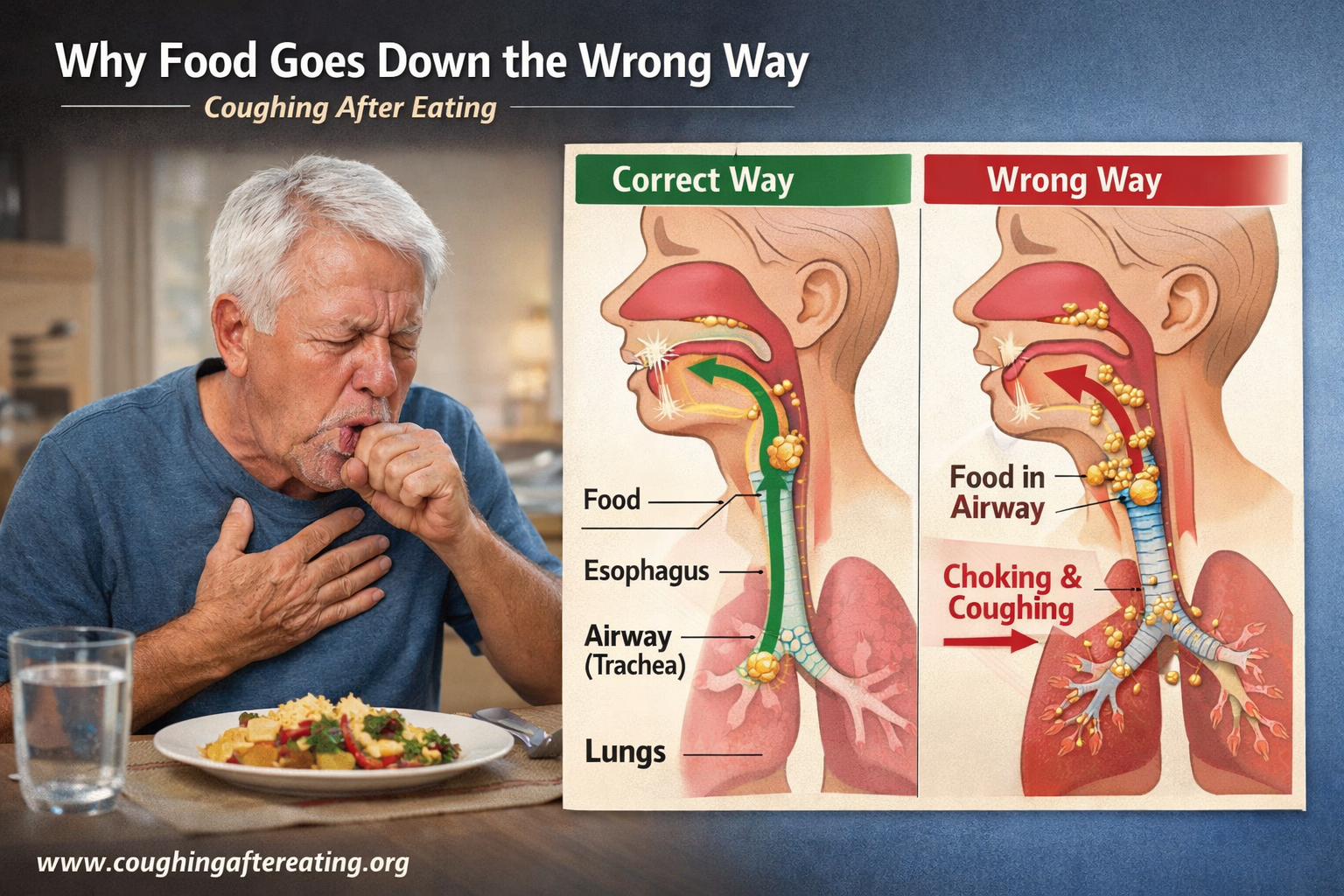
Why food goes down the wrong way and causes coughing after eating
Food going down the wrong way is one of the most common reasons people experience coughing after eating. It happens when food or liquid enters the airway instead of the esophagus, triggering an immediate cough reflex to protect the lungs.
In most cases, this is occasional and harmless. But if it happens frequently, it can point to an underlying issue with swallowing or airway protection.
If you want a complete overview of all possible triggers, start with this coughing after eating causes guide, which explains how different conditions can lead to coughing during or after meals.
What does “food going down the wrong way” actually mean?
Under normal conditions, swallowing is a highly coordinated process. Food moves from the mouth into the esophagus, while the airway is temporarily sealed off by a flap called the epiglottis.
When food goes “down the wrong way,” this coordination briefly fails. Instead of entering the esophagus, a small amount of food or liquid slips into the airway. This is known as aspiration.
Even a tiny amount is enough to trigger coughing. This is medically known as aspiration when eating and coughing, where food enters the airway instead of the esophagus. The airway is extremely sensitive, and the body reacts instantly to clear anything that does not belong there.
Why does coughing happen immediately after this?
The cough reflex is one of the body’s fastest protective responses. The moment food or liquid touches the airway, sensory nerves send signals to the brain, which immediately activates a forceful cough.
This is why coughing after eating can feel sudden, intense, and sometimes uncontrollable. It is not a random reaction. It is your body actively trying to prevent choking or deeper lung entry.
In most cases, the coughing stops once the airway is cleared. However, repeated episodes suggest that something is interfering with normal swallowing coordination.
Common reasons food goes down the wrong way
There are several everyday and medical reasons why food may enter the airway instead of the esophagus.
Eating too fast or not chewing properly
Eating quickly reduces the time your body has to coordinate swallowing. Large or poorly chewed pieces of food are harder to control and more likely to misdirect.
Talking, laughing, or being distracted while eating can further disrupt this coordination, increasing the chance of coughing.
Drinking liquids too quickly
Liquids move faster than solid food and require more precise timing during swallowing. If the airway does not close at exactly the right moment, liquids can slip in easily.
If this happens often, it helps to understand why coughing happens after drinking liquids, as this pattern is very common.
Mild swallowing incoordination
Sometimes the muscles involved in swallowing do not work in perfect sync. This can happen when you are tired, unwell, or not fully focused while eating.
Even a slight delay in airway closure can allow food or liquid to enter the wrong passage.
Acid reflux and throat irritation
Chronic irritation from acid reflux can affect how well the throat protects the airway. Over time, this may make it easier for food to misdirect during swallowing.
If reflux might be contributing, it helps to understand why GERD causes coughing after eating, as the connection is often overlooked.
When this becomes a medical concern
Occasional coughing after eating is common and usually not a cause for concern. However, frequent or worsening episodes may indicate an underlying swallowing problem.
Conditions like dysphagia or neurological disorders can interfere with the body’s ability to coordinate swallowing safely.
Pay attention if you notice patterns such as:
- Frequent coughing or choking during meals
- A sensation of food sticking in the throat
- Coughing with almost every sip of liquid
- Recurrent chest infections
- Unexplained weight loss
These signs suggest that the airway may not be adequately protected during swallowing.
Aspiration vs choking: what’s the difference?
Although they can feel similar, aspiration and choking are not the same.
Aspiration occurs when food or liquid enters the airway without completely blocking it. This usually triggers coughing as the body tries to clear it.
Choking, on the other hand, involves a blockage that prevents air from passing through. This is a medical emergency that requires immediate action.
Repeated mild aspiration can happen without obvious choking, which is why it often goes unnoticed at first.
Why some people experience this more often
Certain groups are more prone to food going down the wrong way due to underlying factors that affect swallowing.
Older adults
As the body ages, swallowing muscles can weaken and reflexes may slow down. This makes it harder to protect the airway consistently.
People with neurological conditions
Conditions such as stroke, Parkinson’s disease, or nerve-related disorders can disrupt the coordination required for safe swallowing.
Individuals with chronic throat irritation
Persistent irritation from reflux, allergies, or sinus-related issues can interfere with normal swallowing patterns.
If throat irritation is a recurring issue, it is worth understanding why throat clearing happens after eating, as these symptoms often occur together.
Why liquids often trigger coughing more than food
Many people notice that coughing happens more frequently when drinking liquids than when eating solid food. This is not a coincidence.
Liquids flow quickly and require precise timing between swallowing and airway closure. If that timing is slightly off, liquids can reach the airway before it is fully protected.
Thin liquids like water are especially likely to trigger coughing. In some cases, thicker liquids are easier to control and less likely to misdirect.
How to reduce the risk while eating
For most people, simple changes in eating habits can significantly reduce how often food goes down the wrong way.
Improving awareness and slowing down the eating process allows the body to coordinate swallowing more effectively.
- Eat slowly and take smaller bites
- Chew food thoroughly before swallowing
- Avoid talking while eating
- Sit upright during meals
- Take small, controlled sips instead of large gulps
- Stay focused while eating rather than distracted
These small adjustments can make a noticeable difference in preventing coughing after eating.
When to seek medical advice
If coughing after eating becomes frequent or persistent, it should not be ignored. Repeated aspiration can irritate the lungs and, over time, may lead to complications.
A healthcare provider can assess swallowing function and identify whether there is an underlying issue that needs treatment.
You should consider seeking medical advice if coughing happens daily, worsens over time, or is accompanied by difficulty swallowing, fatigue, or recurrent respiratory problems.
Final takeaway
Food going down the wrong way and causing coughing after eating is usually a normal protective response. It shows that the body is actively working to keep the airway clear.
However, when it happens frequently, it may indicate a deeper issue with swallowing coordination or airway protection. If this symptom happens often, reviewing the coughing after eating causes guide can help you understand the bigger picture.
Understanding the cause helps you take the right steps to reduce episodes and recognize when further evaluation is needed.
When food enters the wrong passage, coughing is not a problem – it is the body’s first line of defense.